
Beyond Muscles and Joints: What I've Been Learning About Fascia, the Pelvis, and Whole-Body Health
New insights into the relationships between pelvic anatomy, connective tissue, movement, and long-term well-being.

What I Learned from Advanced Training (and What It Means for You)
One of the things I love most about this work is that the learning never stops.
As part of my ongoing studies in Visceral Manipulation through the Barral Institute, I recently completed an advanced training focused on the pelvis. While much of my work has centered around fascia, movement, posture, and structural relationships throughout the body, this course offered another perspective on how interconnected our systems truly are.
One of the biggest takeaways wasn't learning about a single structure. It was gaining a deeper appreciation for how the pelvis serves as a meeting point between movement, pressure, fascia, nerves, and the body's internal organs.
The more I learn, the more I am reminded of a principle that has guided my work for years:
The body rarely functions as separate parts.
The Pelvis Is More Than a Collection of Structures
When most people think about the pelvis, they tend to think of the hips, low back, or pelvic floor.
What fascinated me throughout this training was how many systems converge in this region.
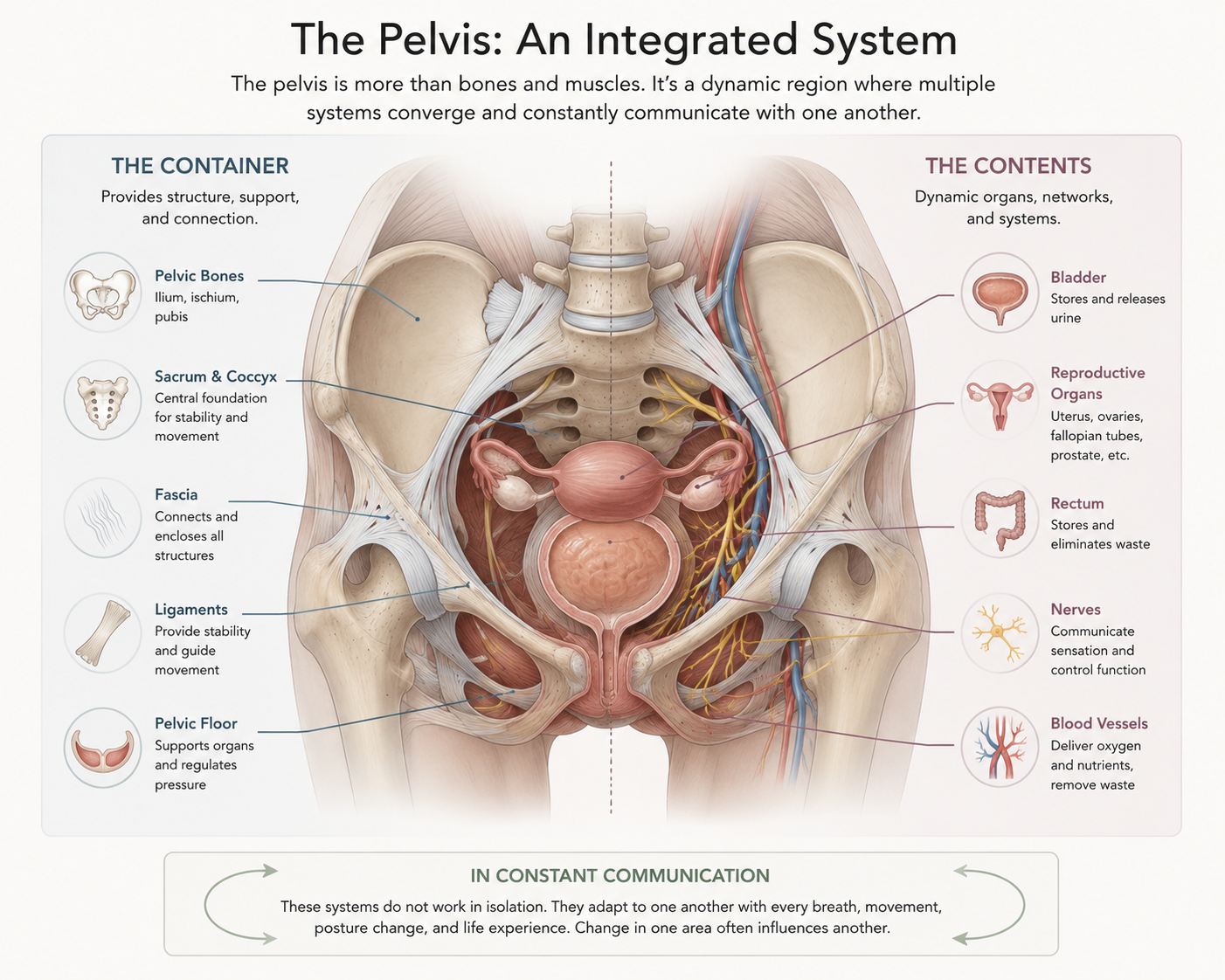
The pelvis contains an intricate relationship between bones, ligaments, fascia, nerves, blood vessels, and organs. Rather than functioning independently, these structures are constantly adapting to one another.
One of the recurring themes throughout the course was the relationship between what instructors referred to as the "container" and the "contents."
The container includes the pelvic bones, sacrum, coccyx, fascia, ligaments, and pelvic floor. The contents include structures such as the bladder, reproductive organs, rectum, nerves, and vascular networks.
What became increasingly clear is that these systems are in constant communication. Changes in one area often influence another.
As someone who works extensively with posture and movement patterns, I found these relationships especially fascinating.
A New Appreciation for the Body's Pressure System
One concept that stood out throughout the training was the importance of pressure management.
Every breath we take creates pressure changes throughout the body.
The diaphragm, abdominal wall, pelvic floor, spine, and pelvis all work together to help regulate these forces. Whether we're breathing, exercising, lifting, coughing, laughing, or simply moving through daily life, pressure is constantly being managed and redistributed.
When this system functions efficiently, movement tends to feel easier and more adaptable.
When it doesn't, the body often finds alternative strategies.
Over time, these compensations may contribute to patterns of tension, postural adaptations, and altered movement mechanics.
This reinforced something I often observe in practice: symptoms are rarely the result of a single structure acting alone.
The Fascial Connections Most People Never Think About
One of the most interesting parts of the course involved studying the connective tissue relationships surrounding the bladder and other pelvic organs.
Many people think of organs as isolated structures, but they are actually supported by layers of fascia and connective tissue that connect them to surrounding areas throughout the body.
We explored how the bladder relates to the abdominal wall, pubic bone, pelvic floor, sacrum, and surrounding fascial layers.
One particularly fascinating structure was something called the urachus, a connective tissue relationship extending between the bladder and the navel.
Most people have never heard of it.
Yet it serves as another reminder that areas of the body we often think of as separate may be connected through layers of fascia and connective tissue.
The deeper we explored these relationships, the more the body's interconnected design became apparent.
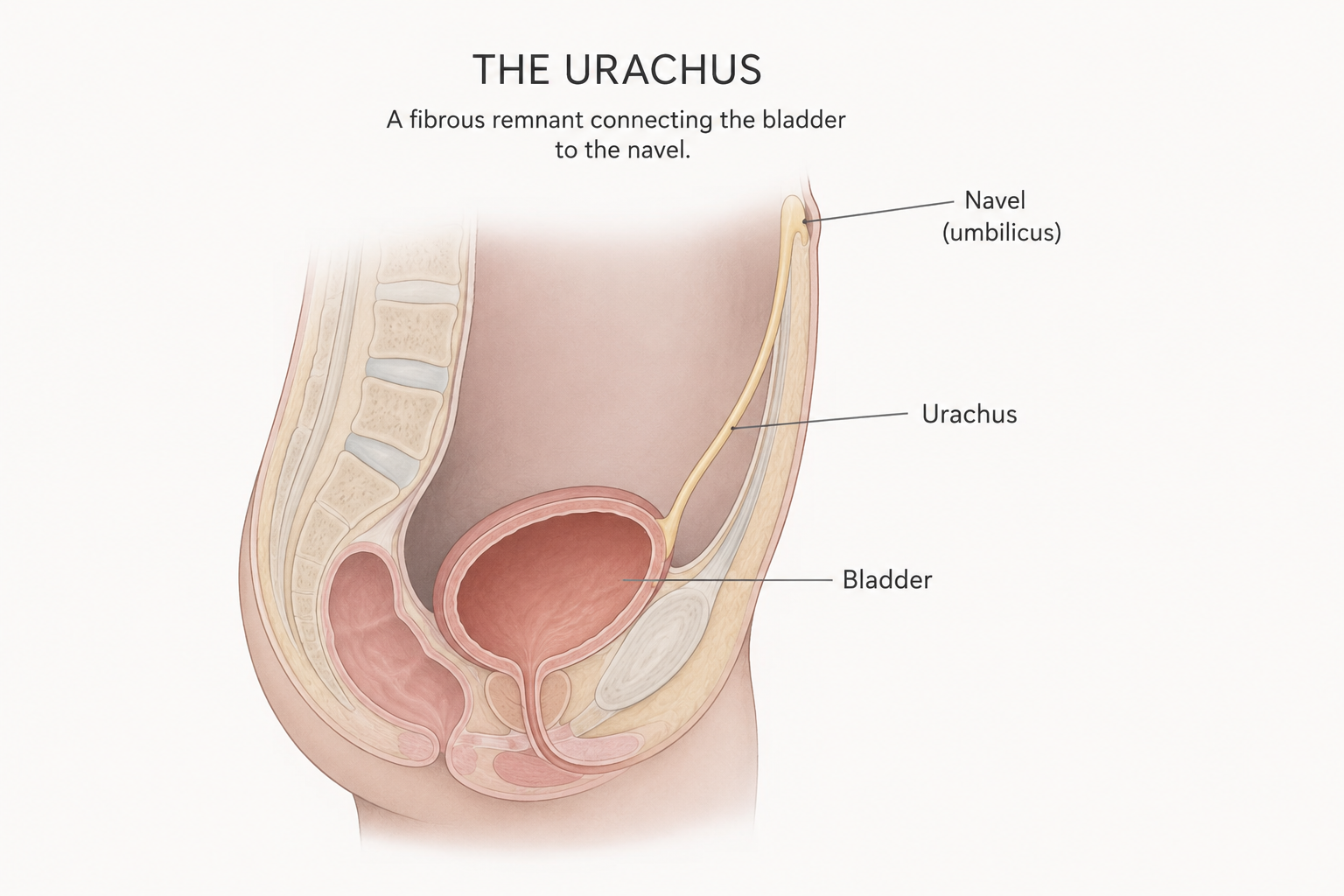
The urachus is a fibrous connective tissue remnant that extends between the bladder and the navel, helping illustrate the body's interconnected fascial relationships within the lower abdomen.
When Muscles May Be Responding to Something Else
Another concept that strongly resonated with me involved the relationship between the organs, nervous system, and muscles.
When people experience chronic tension, it's easy to assume that the muscle itself is the problem.
Sometimes that's true.
But sometimes muscles are responding to information coming from elsewhere.
The course explored how irritation, restriction, or altered movement within one tissue can create protective responses throughout the system.
This doesn't mean every muscle problem originates from an organ or visceral structure.
What it does highlight is the importance of looking at the whole person rather than focusing exclusively on the area where symptoms appear.
This perspective aligns closely with how I already approach structural integration and fascial bodywork.
Rather than chasing symptoms, I am always interested in understanding the larger pattern.
Healthy Organs Move
One of the simplest ideas from the course was also one of the most impactful.
Healthy organs move.
The bladder expands and adapts. The reproductive organs move within their supporting tissues. The ureters glide between the kidneys and bladder. The pelvic floor continuously adjusts to changes in breathing, posture, and movement.
Just as we think about mobility and adaptability within muscles, joints, and fascia, we can also appreciate the importance of mobility and adaptability within the body's internal structures.
Perhaps the most surprising realization was that healthy organs are not static.
They are constantly moving, responding, and adapting throughout the day.
Scar Tissue, Surgery, and Adaptation
Another area of study focused on how the body adapts following surgery, injury, pregnancy, and other life experiences.
Even when healing occurs successfully, connective tissues often reorganize around those events.
Over time, the body may develop movement strategies that persist long after the original issue has resolved.
This reinforced the importance of understanding a person's history when evaluating posture, movement patterns, and areas of chronic tension.
The body remembers.
And sometimes those adaptations continue influencing movement years later.
The Nervous System's Role in the Bigger Picture
Another fascinating area of study was the amount of neurological communication taking place throughout the pelvis.
The bladder, pelvic floor, reproductive organs, sacrum, and brain are constantly exchanging information through an intricate network of nerves and nerve plexuses.
These communication pathways help coordinate movement, pressure regulation, muscle activity, and organ function.
They also help explain why changes in one area can sometimes influence seemingly unrelated regions of the body.
For someone who already works extensively with fascia, movement, and nervous system regulation, this was an especially valuable perspective.
What This Means for My Clients
While this training expanded my understanding of pelvic anatomy and visceral relationships, it doesn't change the foundation of how I work.
If anything, it reinforces it.
The value of this education is not about focusing on individual organs in isolation. It's about gaining a broader understanding of how connective tissue, movement, pressure systems, scar tissue, the nervous system, and internal structures influence one another.
It provides another lens through which to view the body as an integrated system.
And that perspective continues to shape how I assess movement, tension patterns, and structural relationships throughout the body.
What I've Learned
If there was one lesson that stood out above all others, it would be this:
The body is remarkably interconnected.
Muscles influence organs. Organs influence movement. Fascia connects regions that seem unrelated. Pressure systems affect posture. The nervous system coordinates it all.
The more I study anatomy, fascia, and human movement, the less I see separate parts and the more I see relationships.
And in many ways, understanding those relationships is where the most meaningful learning begins.
Looking for a Whole-Body Approach to Pain, Tension, and Movement in Los Angeles?
If you're in Los Angeles and dealing with persistent tension, movement restrictions, postural imbalances, or symptoms that don't seem fully explained by the area where they're felt, a whole-body approach may be worth exploring.
I offer sessions in Manhattan Beach, Playa Vista, and Santa Monica, supporting clients through integrative bodywork, structural integration, and fascia-focused care designed to address patterns throughout the body, not just isolated symptoms.
Who This Is For
This work may be especially supportive if you experience:
Persistent low back, hip, or pelvic tension
Movement restrictions that keep returning
Postural imbalances or compensatory patterns
A history of abdominal or pelvic surgery
Chronic tension that doesn't fully resolve with traditional approaches
A desire to better understand how different systems of the body work together
Frequently Asked Questions
Q: What is Visceral Manipulation?
A: Visceral Manipulation is a gentle manual therapy approach that explores the mobility and fascial relationships of the body's internal structures and how they interact with movement, posture, and surrounding tissues.
Q: Does this work focus on organs?
A: The goal is not to treat organs in isolation, but to better understand how internal structures, connective tissue, movement patterns, and the nervous system influence one another.
Q: Why is the pelvis so important?
A: The pelvis serves as a meeting point for movement, pressure regulation, fascia, nerves, and internal organs. Changes in one area can often influence function elsewhere.
Q: Can scar tissue affect movement patterns?
A: Scar tissue and previous surgeries can influence how tissues move and adapt. Over time, the body may develop compensatory patterns that persist long after healing has occurred.
Q: What does it mean that "healthy organs move"?
A: Just like muscles, joints, and fascia, the body's internal structures are designed to adapt and move throughout the day. Mobility and adaptability are important aspects of healthy function.
Quick Summary
The pelvis is an integrated system involving fascia, organs, nerves, movement, and pressure regulation
Symptoms are not always caused by the area where they are felt
The body's internal structures are connected through complex fascial relationships
Pressure management plays an important role in posture, movement, and overall function
Scar tissue, surgery, and life experiences can influence how the body adapts over time
Lasting change often comes from understanding relationships within the body rather than focusing on isolated symptoms
