
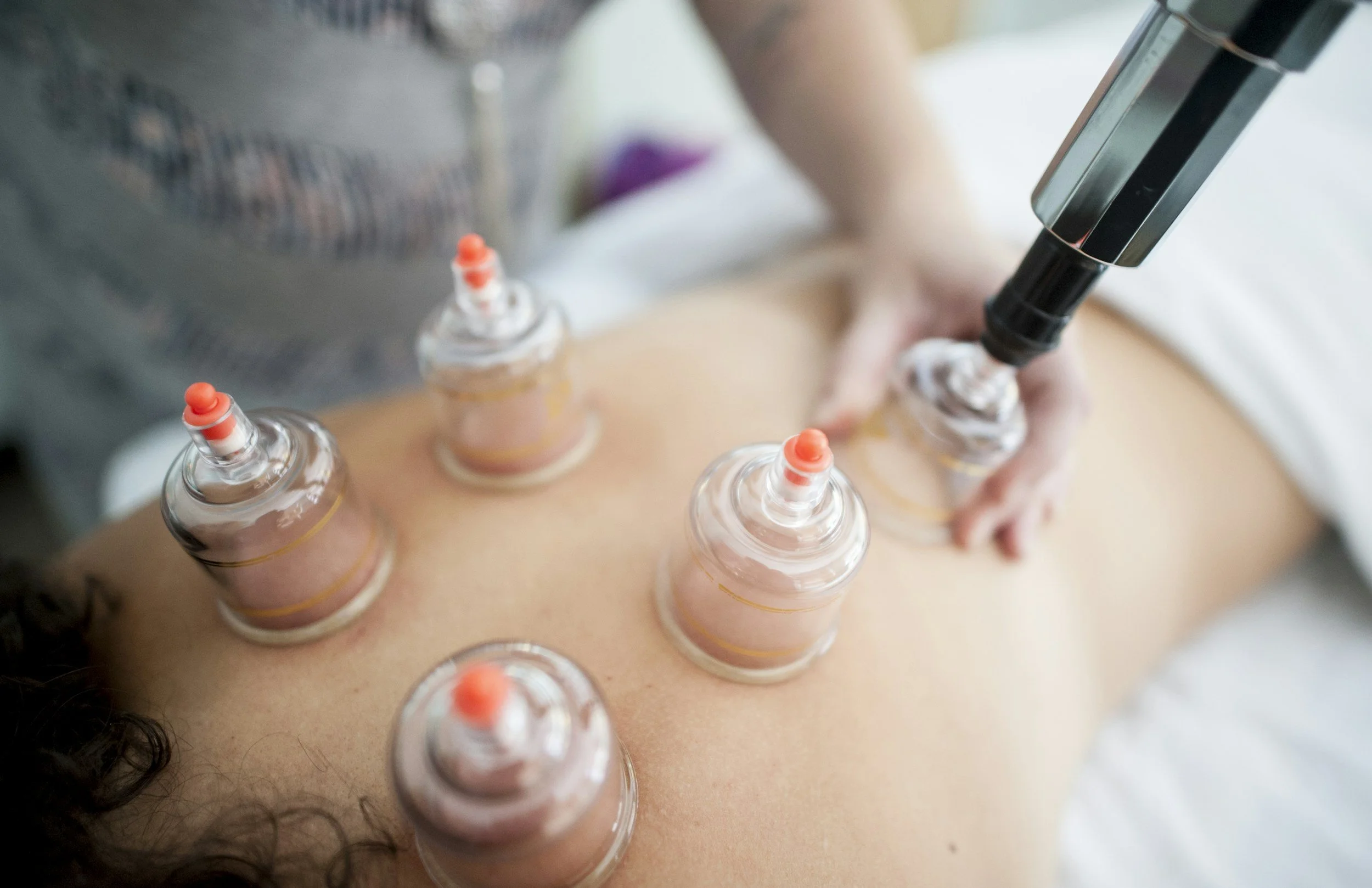
Cupping is an ancient therapy that has evolved into a modern, highly effective tool for fascial release, pain relief, and improving fluid movement throughout the body. In my practice, I use multiple styles of cupping—each with a different purpose—so sessions are always customized based on what your body needs that day.
While many people think of cupping as simply “suction marks on the skin,” the real value lies deeper: in how it decompresses tissue, restores glide between layers of fascia, increases circulation, and gives the nervous system new sensory input to reduce tension.
My Approach: Cupping Through the Lens of Fascial Lines
Instead of placing cups “at random,” I assess the body using fascial lines—such as the superficial front line, back line, spiral line, and deep front line—to locate where tissue tension is pulling, restricting movement, or contributing to pain somewhere else in the body.
Sometimes the pain someone feels in one area is actually caused by a restriction along that fascial chain. Cupping allows me to lift and decompress instead of only pressing and pushing like with traditional massage. This is especially helpful for reaching deeper layers, such as the investing fascia around the muscles, that are difficult to access with hands alone.
Every session is different because every body is different.
Types of Cupping I Use in Bodywork Sessions
1. Vacuum / Myofascial Cupping (Silicone or Pump Cups)
Creates suction that lifts tissue rather than compressing it
Helps separate fascial layers, improve glide, and reduce trigger points
Can be static (left in one spot) or dynamic (moved along a fascial line)
Ideal for chronic tension, athletic recovery, posture work, and old adhesions
Research: A case series showed that combining static and dynamic myofascial cupping improved pain and function in low back pain by restoring fascial glide.
Research: Studies indicate the suction may alter the viscosity of hyaluronic acid in the fascia, improving glide.
2. Fire Cupping (Traditional Chinese Medicine)
A flame quickly removes oxygen from the cup, creating a natural vacuum
Warmer, deeper, and often more penetrating than plastic pump cups
Used to move “stagnation” and increase blood flow according to TCM principles
Especially helpful for deep muscular tension, cold/stagnant tissue, and stress
While specific high-quality RCTs on fire cupping alone are more limited, the general cupping literature supports pain relief and circulation improvements.
3. Lymphatic Cupping (Low Suction, Machine-Assisted)
Uses gentle, rhythmic vacuum pressure to support lymph drainage
Great for inflammation, swelling, immune support, post-surgical clients, or detox work
Does not leave marks because the goal is fluid movement, not deep fascial release
Often paired with manual lymphatic drainage and light fascial work
Research: The increased oncotic pressure from dry cupping is believed to stimulate lymphatic uptake, facilitating removal of interstitial fluid.
Research: Cupping has been used as a complementary therapy in chronic edema/lymphatic conditions and may perform better than manual lymph drainage in some cases.
4. Deep Fascial Decompression (Targeted for Adhesions & Mobility)
Slow, focused cup placement along stuck fascial lines to reach deep investing fascia
Can help restore range of motion, reduce nerve entrapment symptoms, and improve posture
Often combined with movement integration and neuromuscular re-education
Research: Basic science MRI work shows cupping can pull not only subcutaneous tissue but also deeper muscle/fascial tissue, improving tissue glide for days.
Why Cupping Works So Well for Fascia
Fascia responds to decompression, hydration, neurological input, and movement. Cupping addresses all four by:
✔ Lifting tissue instead of compressing it
✔ Stimulating fresh blood flow and lymph circulation
✔ Creating space between layers so muscles can contract and lengthen fully
✔ Allowing the nervous system to down-regulate protective tension patterns
In more clinical terms:
The negative pressure creates micro-mechanical deformation of tissue-layers, which may lead to increased fibroblast activity, tissue remodelling, and improved collagen alignment.
The suction has been shown to increase local blood flow and reduce capillary filtration pressures—beneficial for stagnant tissue and microcirculation.
By restoring fascial glide (via altering hyaluronic acid viscosity under suction + heat) you can reduce restrictions and improve mobility.
What the Research Shows (and Doesn’t Yet)
What is supported:
Cupping shows short-term pain relief and improved function in some musculoskeletal conditions (e.g., low back pain, plantar fasciitis) compared with no intervention.
Myofascial cupping shows promise in improving tissue mobility (e.g., hamstrings) and reducing stiffness by targeting fascial glide mechanics.
Lymphatic cupping techniques may enhance lymph flow, reduce edema, and support fluid movement—especially in adjunctive roles.
What is less clear / needs further study:
Long-term outcomes: Many studies show short-term improvements, but fewer show sustained results over months or years.
Mechanistic clarity: While there are hypotheses (e.g., fascial glide, hyaluronic acid viscosity changes), more rigorous human trials are needed.
Comparative effectiveness: How cupping compares directly with other manual therapies (e.g., myofascial release, IASTM) in many populations is still emerging. For example one recent study found both cupping and myofascial release improved low back pain similarly.
Safety & protocol standardization: Suction intensity, duration, cup placement, static vs dynamic movement—all vary widely in research and practice.
So, while I use cupping confidently in my practice, it’s important to communicate to clients that it’s part of a holistic plan—not a panacea.
And yes… I also offer “love cupping.”
Because this is LA, and sometimes classic round cupping marks get a little boring. In my practice, I use both traditional cups and heart-shaped cups so your marks can feel a bit more fun and intentional. If you’re going to walk around with visible cupping circles on your back, they might as well be something cute—little hearts that reflect personality, self-care, and a sense of play while still providing the same therapeutic benefits.

FAQ: Common Questions & How I Approach Them
Q: Will the cupping marks mean I’m bruised or injured?
A: Usually not in the sense of injury. The reddish-purple marks (called ecchymoses) come from mild capillary dilation and suction pulling blood into superficial vessels. They are common with higher suction and static placement. In lymphatic/low-suction cupping they often don’t appear. Marks typically fade in a few days. I always explain mark expectations ahead of time.
Q: Does it hurt?
A: Most clients report a comfortable suction pull rather than pain. If the tissue is highly irritated or inflamed, I adjust suction lower or choose a gentler style (e.g., lymphatic cupping). Any discomfort during the session is checked in real-time; you should be able to relax into it. After the session you may feel warmth or mild ache, which often resolves by next day.
Q: How many sessions will I need?
A: Because everyone’s body is different, I don’t use a “one size fits all” number. Some clients experience meaningful relief after one session; others with chronic restrictions may benefit from 3-6 sessions spaced over weeks, followed by movement re-integration. I’ll assess your response and collaboratively adjust.
Q: Are there any contraindications or risks?
A: Yes. Some contraindications include: open wounds or broken skin, active infections, deep vein thrombosis, severe skin conditions, certain bleeding disorders, and in some cases pregnancy (depending on site). For lymphatic cupping: if you have acute infection, uncontrolled cardiac/renal disease, or clotting risks, we proceed with caution. Research notes that, for example, one case reported lymphedema triggered after wet cupping in a post-breast-cancer patient. I always take a full health history and discuss risks/benefits.
Q: Can I combine cupping with other modalities (massage, Rolfing®, yoga, movement)?
A: Absolutely—and I believe this is where the real value lies. I often integrate cupping within a session of structural integration, movement re-education, or myofascial release. Cupping opens the tissue; we then reinforce it with movement or neuromuscular work. That synergy supports longer-lasting results.
Q: What about detoxification claims / “removing toxins”?
A: While the term “toxins” is used widely in marketing, from a clinical research standpoint the language is more precise: cupping may increase interstitial fluid movement, enhance lymph-uptake, improve microcirculation, and reduce stagnation of fluid. For instance, suction has been shown to stimulate lymphatic uptake. I discuss this with clients in clear terms—it’s not a mystery detox cure, but rather a tool to enhance circulation, tissue mobility, and fluid dynamics.
Q: When should I expect to see results?
A: Some clients feel easier movement or less pain immediately or the next day. Others notice improvement after 2-3 sessions as adaptations occur (fascial glide improves, tissue inflow/outflow balances). I typically ask for a 1 week check-in and a 3-session block to assess meaningful progress.
Q: Will I be sore afterwards?
A: Occasionally yes—especially when working deep restrictions. The soreness is usually mild (like the feeling after a good workout) and resolves within 24-48 hours. If you experience sharp pain, increased swelling, or unusual symptoms, you should contact me (or your healthcare provider).
Q: Does this replace massage or physical therapy?
A: No—it’s complementary. Cupping is a modality that enhances what manual therapy, movement work, and strength training do best. Many of the most effective outcomes come when we combine cupping with corrective exercises, posture/movement coaching, and ongoing tissue care. I often coordinate with your other health providers when needed.
If you’re curious to try cupping or want it integrated into your next session, simply say the word. When we meet, I’ll assess your posture, movement patterns, fascial lines, and together we’ll select the cupping style that best serves your body’s current needs. Let’s work together so you can move better, feel freer, and stay strong.
