
Jaw Clenching & Nervous System Patterns in Los Angeles
Whole Body Jaw Clenching & Bruxism Support in Playa Vista, Santa Monica & Manhattan Beach
“Jaw clenching isn’t a jaw problem — it’s a nervous system strategy.”
Many people seeking jaw tension relief in Los Angeles are surprised to learn that jaw clenching isn’t just a dental or muscle problem, it’s a nervous system pattern where your body uses the jaw as a stabilization strategy. This pattern shows up as tension, headaches, and bruxism in people across Playa Vista, Santa Monica, Manhattan Beach, and greater Los Angeles, even when stress doesn’t feel overt.
If you experience jaw tension, headaches, neck pain, facial tightness, or a sense of constant holding in your body, you’re not alone. In my practice, I see an increasing number of clients dealing with jaw clenching and bruxism throughout the day and night, with many of them located in Playa Vista, Santa Monica, Manhattan Beach, and the greater Los Angeles area.
Here’s the most important shift happening in current research and clinical practice:
Jaw clenching is no longer viewed as a simple dental or muscle issue.
It is now understood as a nervous system regulation and stabilization pattern, influenced by stress, posture, breathing, sleep quality, and how the body maintains a sense of safety throughout the day and night.

Most people don’t realize they can alleviate their jaw clenching outside the Dentist Office
Clinical Perspective
In my practice, I see jaw clenching show up most often in people who are highly capable, responsible, and used to holding things together, even when they don’t feel outwardly stressed.
Many clients are surprised to realize they clench during the day while concentrating, driving, exercising, or managing emotional load, and that this same pattern often continues at night. When we stop treating the jaw in isolation and instead support the nervous system, breathing, posture, and whole-body stability, the jaw often no longer needs to work so hard.
WHY Jaw Clenching Happens?
Chronic stress & nervous system hypervigilance
Forward head posture and upper neck tension
Restricted rib cage and diaphragm movement
Nighttime micro-arousals and poor sleep
Mouth breathing & airway instability
What Jaw Clenching Really Is
Jaw clenching — including both awake bruxism (daytime clenching) and sleep bruxism (nighttime clenching) — is recognized as a form of repetitive jaw muscle activity driven primarily by the central nervous system, not by jaw strength or dental alignment alone.
Jaw clenching can occur:
During concentration or mental focus
In response to stress or emotional load
During exercise or physical effort
During postural holding or bracing
During sleep, particularly during micro-arousals
In all cases, the jaw is responding to nervous system demand, not behaving randomly.
The Nervous System’s Role in Jaw Clenching
One of the most influential and often overlooked parts of this nervous system–jaw connection is the upper cervical spine.
The Role of the Upper Cervical Spine (OA, C1 & C2) in Jaw Clenching
The area where the head meets the neck — the occipito-atlantal joint (C0–C1) and the first two cervical vertebrae (C1 and C2) — plays a major role in jaw tension and clenching.
This region sits directly beneath the brainstem and shares neurological pathways with the nerves that control the jaw and face. When there is tension, compression, or limited movement here, it can increase nervous system activity and muscle tone — including in the jaw.
Clinically, this means:
Jaw clenching can be driven by neck and head tension
The jaw may act as a stabilizer when the head and neck don’t feel supported
Forward head posture and upper cervical strain can increase jaw muscle activity
Nighttime clenching may be linked to how the nervous system responds to upper cervical stress during sleep
This is why effective jaw clenching care often includes work at the base of the skull and upper neck — not just the jaw itself.
Gentle, nervous-system–aware work, such as CranioSacral Therapy, can help reduce reflexive clenching by improving support, mobility, and neurological regulation.
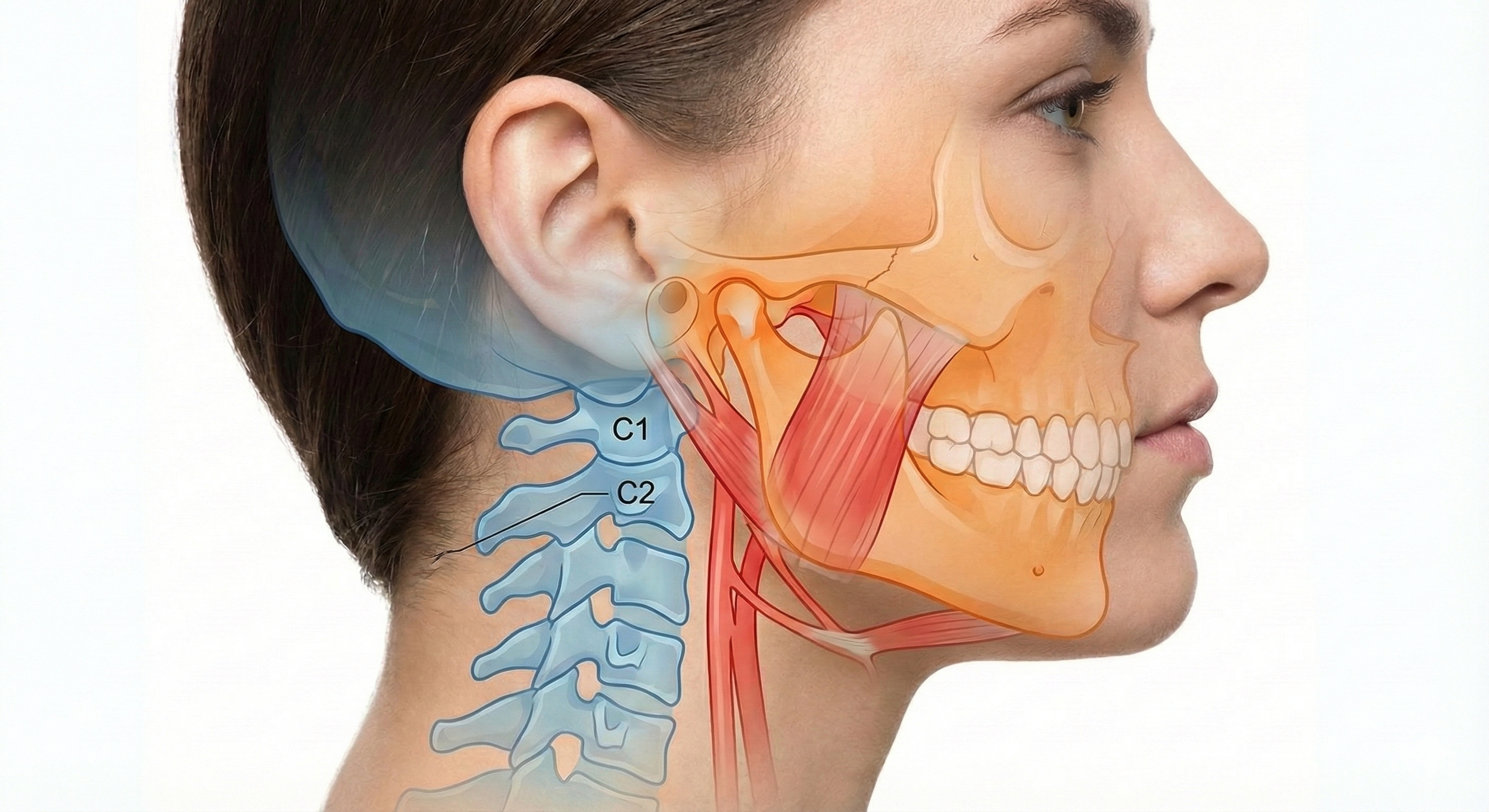
Understanding our anatomy reveals the causes of Jaw Clenching
The jaw is one of the body’s most powerful stabilizers. Neurologically and fascially, it is deeply connected to:
The brainstem
The vagus nerve
The upper cervical spine
Breathing and airway regulation
Fight-or-flight and focus responses
When the nervous system perceives instability, threat, overload, or the need for control, the jaw often activates to:
Create internal stability
Increase focus or alertness
Brace the head and neck
Support breathing under stress
This is why many people clench their jaw while working, driving, training, or managing emotional stress — often without any awareness they’re doing it.
Why Jaw Clenching Often Continues at Night
During sleep, jaw clenching most commonly occurs during micro-arousals — brief moments when the nervous system partially wakes.
These arousals are influenced by:
Ongoing stress and mental load
Breathing or airway challenges
Fragmented or poor-quality sleep
Hormonal shifts (including perimenopause)
Sensory stimulation
A nervous system that never fully down-regulates
If the jaw is already being used as a stabilization strategy during the day, it is far more likely to continue that role at night. Nighttime clenching is often the continuation of a daytime pattern, not a separate issue.
Common Contributors to Jaw Clenching We’re Seeing More Often
Jaw clenching is rarely caused by a single factor. Common contributors include:
Chronic stress and cognitive load
High-functioning, “always on” nervous systems
Poor breathing mechanics or mouth breathing
Restricted rib cage and diaphragm movement
Hormonal transitions (perimenopause, menopause)
History of injury, trauma, or long-term tension patterns
Postural compensation and whole-body bracing
Importantly, this is not conscious behavior. Jaw clenching is an automatic nervous system response — not a bad habit or lack of willpower.
Why Jaw-Only Treatments Often Fall Short
Jaw massage, Botox, or night guards may temporarily reduce symptoms, but they often fail to resolve the underlying pattern because they don’t address why the jaw is working so hard.
In many cases, the jaw becomes the end point of a much larger stabilization strategy involving:
The nervous system
Breathing
Head–neck balance
Rib cage mobility
Pelvic and whole-body support
This is why jaw tension often returns when treatment focuses only on the jaw itself.
How Rolfing & Fascial Work Helps
In our practice, jaw clenching is approached as a whole-body pattern, not an isolated symptom. This integrative work is available to clients in Playa Vista, Santa Monica, Manhattan Beach, and surrounding Los Angeles communities.
Work may include:
Rolfing® Structural Integration to reduce compensatory holding and improve support in gravity
Fascial bodywork to release long-standing stabilization patterns
Craniosacral therapy to regulate the nervous system and reduce hypervigilance
Rib cage and diaphragm work to support breathing
Occipital and upper cervical work to reduce jaw–neck coupling
Gentle jaw, tongue, and hyoid work when appropriate
The goal is not to force relaxation — it’s to change the system’s need to clench.

Targeted and supportive Bodywork can greatly aid in alleviating Jaw Clenching
Why Weighted Breathing & Grounding Matter
Gentle weighted breathing on the rib cage or abdomen provides sensory safety signals to the nervous system. This helps reduce vigilance, improve sleep quality, and decrease jaw clenching intensity.
This isn’t about “trying harder to relax.”
It’s about giving your body the right information so it no longer needs to grip.
The Goal Is Not to Stop Clenching — It’s to Change the Need to Clench
When the body feels supported, balanced, and safe, jaw clenching often decreases naturally.
This is why clients frequently report:
Less jaw tension
Improved sleep quality
Reduced headaches
Easier breathing
A sense of calm they didn’t know they were missing
Who This Is For
Individuals waking with jaw soreness or headaches
Professionals under chronic stress in Los Angeles
Clients with sleep-related bruxism
Those who have tried TMJ therapy without lasting results
Anyone seeking whole-body jaw tension relief
Want Help With Jaw Clenching or Bruxism?
If jaw tension, sleep disruption, headaches, or chronic holding patterns sound familiar, this work may be a powerful next step. I work with clients seeking jaw clenching relief, bruxism support, Rolfing®, fascial bodywork, and craniosacral therapy in Playa Vista, Santa Monica, Manhattan Beach, and the greater Los Angeles area.
This article reflects patterns I observe regularly in hands-on clinical practice and is intended for educational purposes only. Jaw clenching and tension patterns vary from person to person, and care is always individualized.
Frequently Asked Questions
Q: Do night guards fix jaw clenching?
A: Night guards can protect teeth but often don’t address why the nervous system is driving muscle tension.
Q: Can posture affect jaw tension?
A: Yes — forward head posture and upper cervical strain increase nervous system demand and reflexive jaw holding.
Q: Is jaw clenching stress-related?
A: While stress can contribute, jaw clenching is primarily a nervous system stabilization strategy — not just emotional tension.
Q: Can integrative bodywork help with jaw clenching?
A: Yes — Rolfing, fascial work, and craniosacral therapy help re-train the nervous system’s pattern and reduce compensatory holding.
Quick Summary
Jaw clenching is often a nervous system pattern.
Chronic stress drives unconscious jaw holding.
Treating only the TMJ may miss the root cause.
Fascial bodywork improves structural alignment.
Nervous system regulation supports sustainable jaw tension relief.
Related searches this article addresses:
jaw clenching Los Angeles, bruxism treatment Playa Vista, jaw pain Santa Monica, craniosacral therapy Manhattan Beach, nervous system jaw tension, holistic jaw clenching treatment
