
Pain After GLP-1? Here’s How Rolfing Structural Integration Helps
Learn Why GLP-1 Weight Loss May Cause Pain and Balance Issues, and Where to Find Rolfing Support in Los Angeles
Watch my GLP-1 YouTube Video Here: https://youtu.be/4op27akXcwo
If you’re on a GLP-1 medication like Ozempic®, Wegovy®, Mounjaro®, or Zepbound® and have lost a significant amount of weight, you might be surprised to find yourself dealing with new neck tension, low-back pain, sore feet, or cranky knees.
At our Los Angeles-based practice, we often see this pattern. Rapid weight loss changes your center of gravity, fascia, and nervous system patterns faster than your body can reorganize on its own. This is exactly where Rolfing Structural Integration can make a meaningful difference.
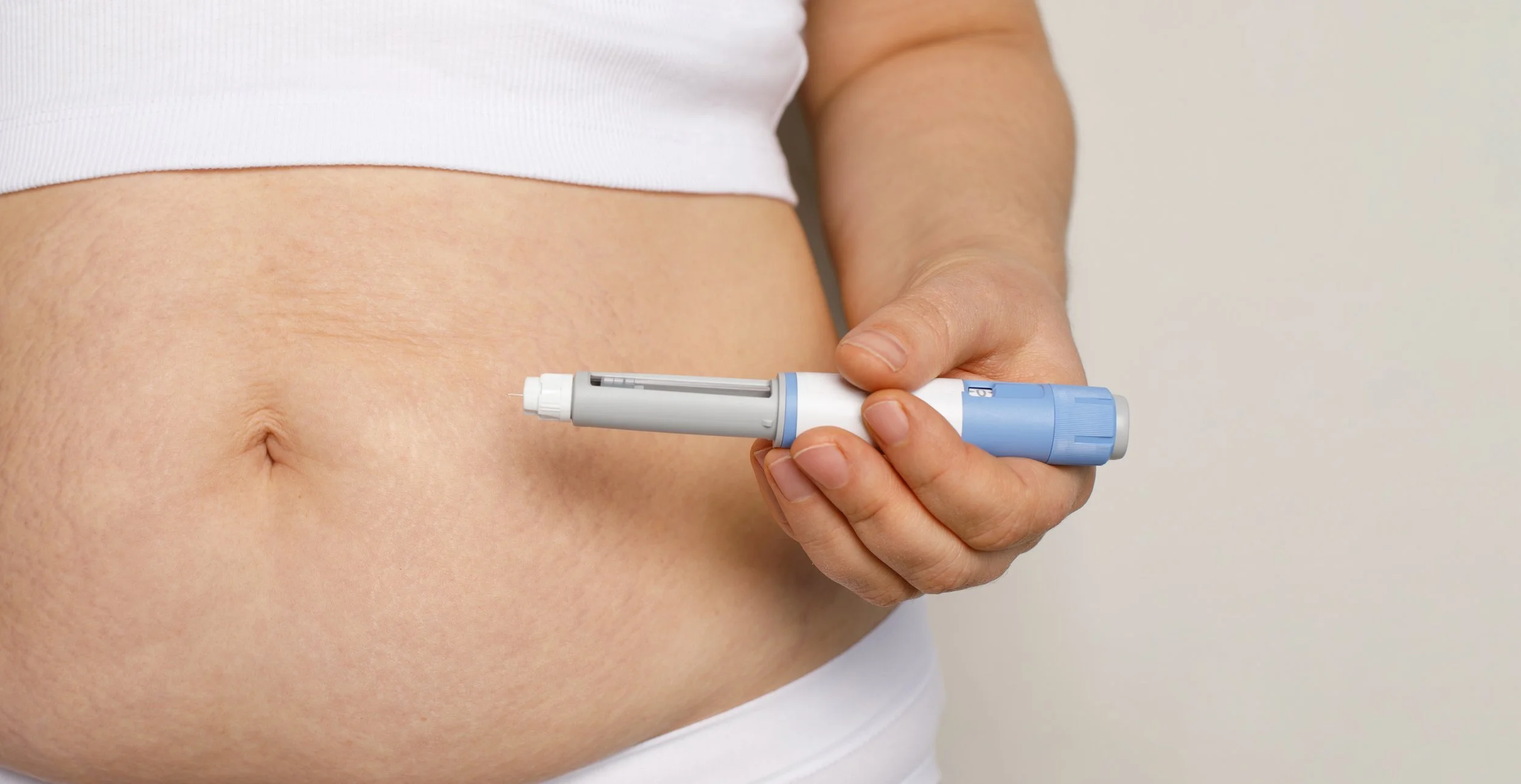
“Despite their metabolic advantages, growing questions concerning the wider physiological effects of GLP-1RAs demand cautious research, especially in relation to their impact on central nervous system (CNS) pathways linked to balance and spatial orientation” (PMID: 40426877)
How Adipose Tissue Changes Your Center of Gravity and Nervous System
People with higher BMIs have a center of gravity, fascia, and nervous system adapted to carrying more adipose tissue, especially around the abdomen. When the volume changes quickly (as it often does with GLP-1 meds), your structure and your nervous system need time and help to reorganize.
Where the weight sits matters
Adipose isn’t just “extra weight”; where it’s stored changes how your body relates to gravity.
Abdominal/visceral fat (android distribution) — fat around the belly, trunk, and upper body — is strongly associated with forward shifting of the body’s center of mass (COM) and changes in spinal curves, especially lumbar lordosis.
Studies looking at people with central adiposity show:
An anterior shift of the whole-body center of mass, which challenges balance and increases the work of spinal and hip musculature.
Increased lumbar lordosis and anterior pelvic tilt, with a higher risk for low-back pain when abdominal fat is high.
Think of it like wearing a heavy backpack on your front 24/7. Your brain quietly tweaks your posture with more lumbar curve, more trunk lean, and more knee and foot adjustments to keep you from falling forward.
Over time, your nervous system normalizes this. These compensations become your “new neutral.”
What Happens When You Lose That Weight Quickly?
GLP-1 receptor agonists can produce double-digit percentage weight loss (often 10–15% or more), with improvements in metabolic health and joint stress.
But the change isn’t just fat loss:
Reviews of GLP-1–induced weight loss show that 20–50% of total weight lost can be lean mass (muscle and other fat-free tissue).
Case reports with dual agonists like tirzepatide show proportional loss of skeletal muscle mass alongside body weight.
From a mechanical standpoint, rapid weight loss leads to:
Reduced joint loading at the knees and hips.
Changed gait patterns and torque at the ankle and knee—what one study called “mechanical plasticity” after large weight loss.
So now, your tissues are lighter, your center of mass has shifted back closer to “normal,” and yet your nervous system is still running the old software:
Same breathing pattern you developed with a heavier abdomen
Same spinal curves and muscle bracing
Same way of loading the arches, knees, and hips
That mismatch between new body and old pattern is a huge reason you feel “off,” unstable, or sore.
Breath, Diaphragm & Abdominal Adipose: Why GLP-1 Clients Still Breathe Like They’re Heavier
Increased abdominal and visceral fat physically pushes the diaphragm upward (cranially) and limits its descent. Studies on obesity and lung function show:
Reduced total lung capacity and functional residual capacity because the diaphragm can’t move down as easily.
Abdominal obesity is linked with lower FVC and FEV1 and more airway closure in lower lung regions.
Clinical overviews note that extra abdominal fat is strongly associated with smaller lung volumes and breathlessness, specifically because it inhibits diaphragm excursion.
When the diaphragm can’t move, your body cheats by:
Over-recruiting scalenes, sternocleidomastoid, and upper traps
Lifting the ribs instead of expanding the lower ribcage
Creating chronic neck and shoulder tension just to ventilate
Here’s the interesting part:
Even after significant weight loss, your nervous system may keep using that old “upper-chest breathing” pattern. That’s why so many post-GLP-1 bodies walk in with:
Tight neck and jaw(Learn more about jaw pain in my blog: Jaw Clenching & Nervous System Patterns in Los Angeles)
Overworked upper ribs and thoracic inlet
Shallow, fast breathing even though the abdomen is now smaller
This is where the breath and fascia connection becomes central, and where Rolfing Structural Integration helps restore diaphragm mobility and nervous system regulation.
Why the Feet, Knees, & Lower Back Complain after Weight Loss
Feet & plantar loading
When you carry more mass:
Ground-reaction forces and plantar pressure increase.
With more anterior COM, the center of pressure under the foot shifts and loading patterns change, increasing shear stresses and risk for plantar pain and lower-extremity injuries.
After rapid weight loss, the loads are lighter, but the movement pattern is still “heavy.” Clients often:
Stay in a wide, externally rotated stance
Over-grip with toes
Roll onto the outside or inside edges of the feet in old, familiar ways
Knees & hips
Obesity research shows:
Greater and more variable knee joint loads and altered gait patterns in people with obesity compared to normal-weight controls.
Weight loss reduces those loads, but the neuromuscular strategy doesn’t automatically normalize.
So post-GLP-1, your knees may no longer be overloaded by mass, but they’re still:
Tracking according to old alignment (valgus/varus habits, rotational patterns)
Responding to trunk and pelvis strategies that were built around a forward-shifted center of gravity
Low back & spinal curves
Multiple studies now connect abdominal obesity with:
Increased lumbar lordosis and altered spinal alignment
Greater gravitational torque on the lumbar spine
Higher likelihood of low-back pain independent of age and activity level.
When the abdominal volume drops quickly, the spine doesn’t magically roll back into neutral. You’re left with:
Ligaments and fascia that have been living in hyperlordosis
Deep spinal stabilizers that got relatively under-used
Superficial back extensors that are used to doing too much
This is exactly the “in-between” phase where hands-on, fascia-focused like Rolfing can work can be powerful. We address the fascial and structural patterns that developed around central adiposity, rather than simply chasing symptoms.
Pains from rapid weight loss are not permanent and can be alleviated through therapies
How Rolfing Structural Integration Reorganizes the Body
Rolfing Structural Integration is a series of 10 progressive sessions designed to reorganize fascia, posture, and movement around gravity.
For GLP-1 and rapid-weight-loss clients, I think of it as updating your body’s operating system to match the new hardware.
Here’s a GLP-1-specific tour through the 10-Series:
Session 1 – Breath & Front Line: Reclaiming Diaphragm Space
Focus: thoracic inlet, ribcage, superficial front line, initial pelvic and neck relationships.
For GLP-1 / significant weight loss:
Help the ribcage and sternum de-brace from years of lifting up to help you breathe over a heavier abdomen.
Free the diaphragm attachments and lower ribs so breath can drop back into the belly and sides, rather than living in the neck.
Begin to reset the nervous system from “emergency upper-chest breathing” to a quieter, more efficient pattern.
Clients often notice:
Neck tension begins to down-shift
Easier, fuller breaths without effort
A sense of “space” in the front body that feels unfamiliar but good
Session 2 – Feet & Lower Legs: Updating the Foundation
Focus: arches, plantar fascia, lower-leg fascial compartments, initial ankle-knee-hip line.
In a post-GLP-1 body:
We address how your center of pressure moves through the foot—heel strike, midfoot, forefoot, toe-off.
Soften the “old heavy step” pattern and help your nervous system trust lighter, more elastic loading.
Re-balance pronation/supination so knees aren’t constantly correcting for foot strategies developed under higher load.
This is huge for clients with foot pain, plantar soreness, or new knee issues after weight loss.
Session 3 – Side Body & Lateral Line: Re-Stacking Head Over Pelvis
Focus: lateral line from ankle to ear—peroneals, IT band region, lateral pelvis, ribs, and neck.
For GLP-1 clients:
Work with the side body that has been counterbalancing a forward-shifted center of gravity.
Help the head and ribcage re-stack over the pelvis instead of living slightly forward or off to one side.
Begin unwinding the patterns that feed one-sided neck tension, shoulder hikes, or “mystery” rib/QL tightness.
Session 4 – Medial Line of the Legs
Work up through adductors and inner line of the legs into the pelvic floor.
Great for knees that have lived in valgus/varus to support a different weight distribution.
Helps refine how the legs carry your new center of gravity in standing and walking.
Session 5 – Front Core: Psoas, Diaphragm, Organ Support
Connects the diaphragm, deep hip flexors, and abdominal wall.
For the post-GLP-1 body, this is where we renegotiate:
Old anterior pelvic tilt + hyperlordosis built around a heavy abdomen.
Chronic psoas overuse from bracing against the forward-shifted COM.
Goal: a spine that can elongate instead of hang on the low back.
Session 6 – Back Line & Sacrum
Works from the soles of the feet up the back fascia, sacrum, and into the spine.
Addresses the overworked erector spinae and thoracolumbar fascia that have been holding you upright against your previous abdominal mass.
This often gives huge relief for chronic low-back tension and glute gripping.
Session 7 – Neck, Head & Jaw
Now that the core and pelvis are more balanced, we free the cranial base, jaw, and cervical fascia.
For GLP-1 clients with neck pain:
This is where we unwind years of accessory breathing (scalenes/SCM/upper traps).
Help the head sit more directly over the thorax so the neck isn’t “carrying” it from in front.
Session 8 – Lower Body Integration
Weave together feet, knees, hips, and pelvis so walking feels coordinated and efficient in your lighter body.
Refine how your center of gravity travels over your base of support with each step.
Session 9 – Upper Body Integration
Coordinate arms, shoulder girdle, ribcage, and head with the now-more-organized pelvis.
Help your nervous system experience turning, reaching, and loading the upper body without defaulting to old neck and upper-trap strategies.
Session 10 – Whole-Body Balance
Final session is about your relationship to gravity as a whole—front/back, left/right, top/bottom.
For GLP-1 clients, this often marks the transition from “I feel like I’m in someone else’s body” to “Okay… this is me now.”
Rolfing helps you feel at home in your new body
Rolfing Updates Your Nervous System to Your New Body
All of this work is not just mechanical. It’s neurological.
Your brain and nervous system build internal “maps” of:
Where your body is in space (proprioception)
How much force is needed to stand, walk, and breathe
What “straight” and “centered” feel like
Years (or decades) of living with higher adiposity change those maps. GLP-1 medications can change your shape fast, but your nervous system is slower to adapt.
Through:
Hands-on fascial work
Gentle movement retraining
Breath work and awareness
Rolfing gives your nervous system a chance to update the map to match your current body. That’s often when the random neck pain, the new low-back twinges, and the confusing foot/knee issues start to resolve not just because there’s less load, but because the load is better organized.
Looking for Rolfing Support in Los Angeles?
At Rolfing and Body Therapies, sessions are provided by a Certified Rolfer® and CAMTC-certified massage therapist trained in fascia-focused, evidence-informed bodywork. Our collaborative healthcare approach supports clients across Los Angeles in Playa Vista, Santa Monica, and Manhattan Beach through structural integration, nervous system regulation, and performance-based recovery. Use the links below to schedule your initial Rolfing session or browse our other therapies!
Who This is For
You’ve lost 10% or more of your body weight on GLP-1 medication
You feel “structurally off” despite improved labs
You developed new low-back pain after weight loss
Your breathing still feels shallow or upper-chest dominant
You’re looking for nervous system regulation alongside structural care
Frequently Asked Questions
Q: Why do I have new pain after losing weight on Ozempic or Wegovy?
Rapid weight loss changes mechanical loading and posture, but your nervous system and fascia may still be operating under old patterns.
Q: Can Rolfing Structural Integration help after GLP-1 weight loss?
Yes. It addresses postural compensation, breathing mechanics, and nervous system regulation rather than just symptom relief.
Q: Is this the same as massage?
No. Rolfing Structural Integration is a systematic, 10-session approach to reorganizing the body around gravity.
Q: Do I need all 10 sessions?
Not always — but the 10-Series provides progressive structural change that is particularly helpful after rapid body transformation.
Q: Is this available in Los Angeles?
Yes. We offer fascial therapy in Los Angeles, including Playa Vista and Manhattan Beach locations.
Quick Summary
GLP-1 medications have powerful metabolic benefits and real potential side effects. Always work with your prescriber if you’re having new or concerning symptoms.
Fascia and spinal curves adapt slowly
The nervous system continues running old movement patterns even after weight loss
Breath and diaphragm mechanics often remain restricted
Rolfing Structural Integration helps reorganize posture and load distribution
Important Note: Rolfing does not replace medical care, but it can be a valuable ally as you adapt to a radically changed body.
📚 Research & Scientific References
Center of Gravity, Posture & Adiposity
Barbosa, J. P. et al. Association between abdominal obesity and postural changes in adults: A systematic review. Journal of Bodywork & Movement Therapies, 2017.
Mignardot, J.-B. et al. The effects of obesity on balance control and the role of plantar mechanoreceptors. Gait & Posture, 2013.
da Silva, L. V. et al. Impact of abdominal obesity on static and dynamic postural control. Clinical Biomechanics, 2017.
Hirabayashi, R. et al. Relationship between body composition and spinal posture in adults with central obesity. Journal of Physical Therapy Science, 2019.
Effects of Obesity on Feet, Knees & Lower-Body Mechanics
Messier, S. et al. Weight loss reduces knee-joint loads in overweight and obese adults with knee osteoarthritis. Arthritis & Rheumatism, 2005.
Hills, A. P. et al. Gait characteristics of obese children and adults: A systematic review. Sports Medicine, 2001.
Wearing, S. et al. The pathomechanics of plantar fasciitis. Sports Medicine, 2006.
Butterworth, P. A. et al. Obesity and foot pain: The Framingham Foot Study. Arthritis Care & Research, 2015.
Breathing Mechanics & Abdominal Adiposity
Jones, R. L., & Nzekwu, M.-M. U. The effects of body mass index on lung volumes. Chest, 2006.
Pelosi, P. et al. Respiratory system mechanics in morbidly obese patients. Journal of Applied Physiology, 1997.
Salome, C. M. et al. Physiology of obesity and effects on respiratory function. Thorax, 2010.
Peters, U. et al. Associations between obesity and asthma: Mechanisms and clinical implications. Journal of Allergy & Clinical Immunology, 2018.
Neuromuscular Adaptation & Postural Compensation
Hodges, P. & Tucker, K. Moving differently in pain: A new theory to explain the adaptation to pain. Pain, 2011.
Butler, D. S., & Moseley, L. Explain Pain. Noigroup Publications, 2013 — foundational text on nervous system patterning.
Proske, U. & Gandevia, S. The proprioceptive senses: Their roles in signaling body shape, body position and movement. Physiological Reviews, 2012.
GLP-1 Medications & Rapid Weight Loss Effects
Wilding, J. et al. Once-weekly semaglutide in adults with overweight or obesity. New England Journal of Medicine, 2021.
Rubino, D. et al. Effect of tirzepatide vs semaglutide on body weight. Lancet, 2022.
Collden, G. et al. GLP-1 receptor agonism and its effects on appetite and metabolism. Cell Metabolism, 2020.
Cruz-Jentoft, A. et al. Sarcopenia and rapid weight loss: implications for muscle mass. Age & Ageing, 2019.
Biomechanics After Weight Loss
Browning, R. C. et al. Effects of obesity and weight loss on biomechanics of walking. Journal of Biomechanics, 2006.
Messier, S. P. Weight loss and knee biomechanics in osteoarthritis. Arthritis Care & Research, 2010.
de Souza, S. A. et al. Postural adjustments after weight reduction in women with obesity. International Journal of Obesity, 2005.
